
Fingerstyle rhythmic rudiments: a systematic approach
Second-hand knowledge
Guitar instruction is organized around the left hand: chord charts, scale diagrams, fretboard maps, even tablature itself. The left hand certainly has more dramatic potential as fingers fly and the hand shifts. The right hand seems to be a mere button pusher, triggering what the left hand has carefully prepared.
Of course, the right hand is not ignored entirely. Beginners are taught how to hold a pick, classical players learn how to place their fingers and what angle of attack to use. Intermediate metal and bluegrass students might spend a lot of time on flatpicking speed.
Fingerstyle guitar, our genre, does devote some early energy to the right hand in the form of picking patterns, notably various Travis or roll-based patterns. A student might learn a few of these or perhaps even a dozen. What tends not to happen, at least outside of classical guitar education, is a systematic approach to right-hand coordination: developing the ability to play melody notes at any point in a measure while keeping a desired bass rhythm chugging along.
This post tries to fill that gap with 256 exercises — a number every software engineer loves. That might seem excessive, a kind of completist insanity. All I can tell you is that some of the most obvious gains I have made as a fingerstyle player have followed periods of deliberate right-hand work, most notably the exercises presented here. Later I will say more about how I worked on this material.
Collectively, the exercises pose this challenge: can you play any rhythmic combination of melody eighth notes while keeping a typical alternating bass going? Drummers build these kinds of coordination skills by practicing rudiments — the foundational sticking patterns and rhythmic patterns they need to play a variety of musical styles. This collection of fingerstyle rudiments has a similar goal. If you can play all of them, you will have the core skills to quickly learn almost any fingerstyle pattern or melody within an alternating or steady-bass context on an eighth-note grid.1 That is a deep and broad musical terrain.
The rudiments explained
The bass is the same across all of the rudiments: the thumb plays alternating quarter notes, cycling through the root and fifth of whatever chord is underneath. That is the backbone.
Also constant are the harmony and structure. Every rudiment consists of eight bars: two each of Am, Dm7, E7, and Am again. The chord voicings are deliberately easy — open chords you already know — and the melody notes are simple, just two or three notes played on the upper strings. The left hand has work to do, but not much. Fingerstyle players ranging from beginners through intermediates will benefit from the coordination skills the rudiments build. For those closer to the beginner end, one useful simplification is to reduce the melody to a single string rather than following the notation strictly.
Here is an example — Ex3.13, the Classic Travis pattern — to give you a sense of what a rudiment looks like:
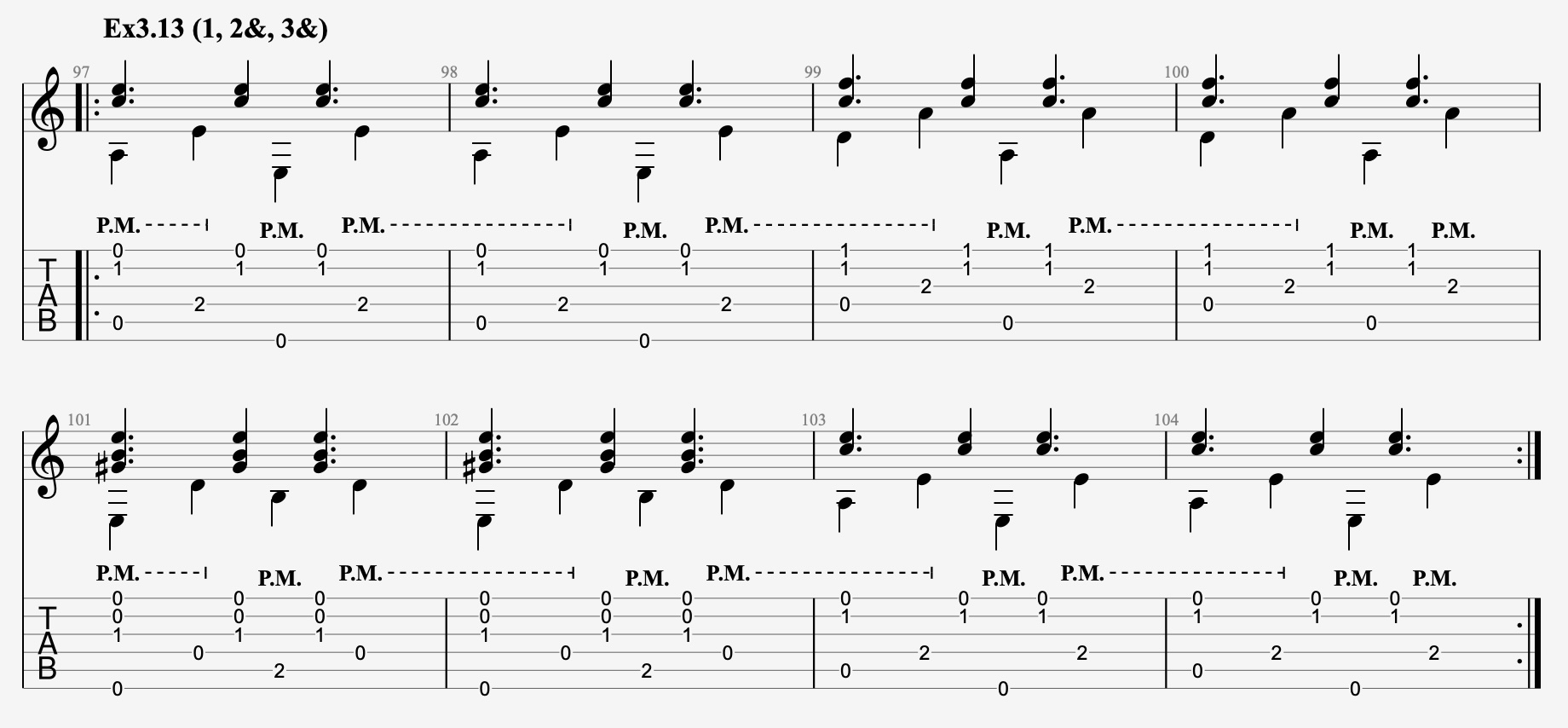
The rudiments are organized by how many times the fingers play per measure. Call that value N. There is a Guitar Pro file for every value of N from 0 through 8.
When N equals 1, the fingers play a melody note exactly once per bar. There are eight possible positions for that single note: any of the on-beats (1, 2, 3, or 4) or the off-beats (1&, 2&, 3&, or 4&). Thus the file “rhythmic-rudiments-ex1.gp” contains eight rudiments, Ex1.1 through Ex1.8.
When N equals 2, the fingers play twice per bar. As you might recall from math class, the number of possible combinations grows rapidly, giving us Ex2.1 through Ex2.28. The number of combinations peaks when N equals 4 and then declines in a mirror-like fashion. At the extremes, there is only one possible arrangement. Here is the full tally:
| N | Rudiments |
|---|---|
| 0 | 1 |
| 1 | 8 |
| 2 | 28 |
| 3 | 56 |
| 4 | 70 |
| 5 | 56 |
| 6 | 28 |
| 7 | 8 |
| 8 | 1 |
| Total | 256 |
How to eat an elephant
Nobody picks up a guitar to drill rudiments — we come for the songs. I approach technical skill-building in small increments: about five minutes at the start of each practice session. The first time I worked through these rudiments, I probably spent a few months on them. At the time I was somewhere in the beginner-to-intermediate range for fingerstyle guitar, so a true beginner would need to budget more time per rudiment than I did.
Some of these exercises are easy — a session or two and they are done. Others might take several days. My advice is not to grind on any single one for too long. Work on it for a bit, set it aside if you are not yet fluent, and come back the next day. Your brain and hands keep working after you put the guitar down. Small bits of steady, focused practice can accomplish more than most people expect.
Whole elephant too much?
If 256 rudiments sounds like more than you want to tackle, there are a couple of ways to reduce the scope.
The first, intended for the maximally impatient or time-constrained, is a bare-bones set of five exercises that represent the essential core of the fingerstyle, roots-oriented genre, drawn from the family of Travis picking patterns — “Five fingerstyle rhythmic patterns you MUST know” in the jargon of our time.
The second is a larger selection, roughly a quarter of the full set, consisting of the rudiments I found most musically interesting. Both are described below.
Travis picking patterns
Some of these rudiments correspond to picking patterns that are well-known in the fingerstyle world. Start with Ex3.13, which most players would recognize as the rhythmic structure of the quintessential Travis picking pattern.2
Strip away one melody note and you get Ex2.3, a minimal Travis variant that sounds great and reveals something important by isolating the defining characteristics of the style: a melody note on beat 1 paired with a syncopated melody note on beat 2&. That is the heart of Travis picking.
Going the other direction — adding a melody note — gives us Ex4.30, the rhythmic shape of the picking pattern used in songs like “Dust in the Wind.” Notice what was added: another syncopated note on beat 4&.
Take one more step and add the final syncopated melody note, on beat 1&, and you arrive at Ex5.15. I tend to call this the Busy Travis pattern, but it could also be called the London pattern for convoluted reasons.3
As a final variation, drop the melody note on beat 1 from Busy Travis and you get Ex4.50 — the rhythmic shape of the outside-inside and inside-outside patterns described in Mark Hanson’s classic “The Art of Solo Fingerpicking.”
| Exercise | Melodic rhythm | Picking pattern |
|---|---|---|
| Ex2.3 | 1, 2& | Minimal Travis |
| Ex3.13 | 1, 2&, 3& | Classic Travis |
| Ex4.30 | 1, 2&, 3&, 4& | Dust |
| Ex5.15 | 1, 1&, 2&, 3&, 4& | Busy Travis / London |
| Ex4.50 | 1&, 2&, 3&, 4& | Outside-inside / Inside-outside |
Quarter elephant: my favorites
When I worked through these rudiments a second time, in preparation for writing this post, I kept a running list of favorites — the rudiments I found most fun to play, those with clear connections to known picking patterns, and those that struck me as having obvious musical potential.
If you work through all of the rudiments, you will discover that some of them are musically quite dull: play a melody note on every downbeat and you get something mechanical, almost robotic. Others, as N grows large, feel more like hand calisthenics than music. I worked through all of them and believe they were useful for skill building, but a fair number felt like chores.
One important caveat: absence from this list should not be read as a negative musical verdict. These rudiments use a static melody: combine that with a predictable rhythm and you get boredom. Some truly wonderful picking patterns — Ex5.15 and Ex4.50 among them — sound unremarkable in the context of a static-melody rudiment but come alive when the melody moves.
| GP file | Favorite rudiments |
|---|---|
| Ex1 | 1, 2, 4 |
| Ex2 | 1, 3, 5, 8, 9, 13, 16, 17, 19, 20, 21, 22, 27 |
| Ex3 | 2, 4, 6, 12, 13, 14, 15, 27, 31, 33, 35, 36, 45, 49, 50 |
| Ex4 | 6, 8, 9, 13, 14, 24, 30, 31, 37, 44, 46, 48, 49, 50, 67, 69 |
| Ex5 | 9, 15, 18, 24, 32, 34, 41, 45, 54 |
| Ex6 | 4, 5, 8, 11, 13, 14, 17, 19, 24, 26 |
A different way to reduce scope is to focus on the lower values of N. Whether you aim to practice all 256 rudiments or just the favorites listed above, the best return on your practice time will come from the first few files. As N increases beyond 3 or 4, the field becomes dense and the musical payoff shrinks somewhat. That said, I think I benefited from working through all of the rudiments. As the number of melody notes increases, the challenge becomes protecting the spaces between notes.
Finding the music
Whether you tackle all 256 or just a subset, treat each rudiment as a musical performance, not a drill. Dynamics, articulation, sustain, and palm muting are all available — use them. Some rhythms work well with a flowing, sustaining approach. Others sound too busy that way; aggressive muting or staccato can clarify things. Occasionally a rudiment that feels uninspiring when plucked in a standard fingerstyle manner becomes interesting when the melody notes are played with more of a strumming motion (Ex2.27 is one example among many).
When approaching chord changes, strategic muting or staccato can convert a moment that might sound clumsy into something intentional. This matters most when melody notes fall on beat 4 or beat 4&, right before the bar line. It is no accident that the Classic Travis pattern contains no 4& melody note. The players who developed these patterns were practical musicians who knew what they were doing.
When to say when
When have you finished a rudiment? My approach was to set a target tempo and stop when I could play the exercise with control and accuracy at that speed. The Guitar Pro files are set at 120 BPM, which is generally where I stopped. For exercises that were more musically appealing, I sometimes raised the bar. Speed was not a primary concern for me.
Variations to consider or reject
You could extend this work in several directions: single melody notes rather than intervals, swing eighth notes rather than straight, a steady bass rather than alternating, or a different chord progression.
The first variation — reducing to a single melody note — is the best simplification for beginners because it narrows the scope to just rhythmic coordination between an alternating thumb and a single melody note.
I am less certain about the other variations. I did not practice these rudiments with swing eighths, though I play a fair amount of music with swing rhythm. My rough sense is that the coordination skills practiced in straight time seemed to transfer readily to swing rhythms.
Regarding steady bass: not worth the trouble. Alternating bass is the harder coordination challenge, and if you can maintain rhythmic independence against an alternating thumb, steady bass will take care of itself. A beginner might reach for steady bass as a simplification, but the left hand work here is already minimalist — dive straight into alternating bass.
Different chord progressions are a more reasonable variation, but I am not sure they are worth pursuing exhaustively. The progression here already covers the primary bass-picking motions that appear in much blues, rock, and traditional fingerstyle music: an Am and a C chord involve the same bass motion; an E7 and a D chord in drop-D tuning share the same motion. The key skills here are rhythmic. Once you have the coordination, applying it to new chords is a left-hand problem.
The goods
At last, here are the Guitar Pro files: Ex0, Ex1, Ex2, Ex3, Ex4, Ex5, Ex6, Ex7, Ex8.
If Guitar Pro is outside your budget there are several applications and websites that can read and play these files. One worth naming explicitly, because it is open-source and free, is TuxGuitar. It handles most of what Guitar Pro does.
-
I say “almost” because some musical material involves different combinations of right-hand fingering that can feel challenging or counterintuitive. But examples like this are not particularly common once you have achieved the ability to play the rudiments presented here. ↩
-
Travis picking as a named technique is partly a modern construct. My rough understanding is that the historical Merle Travis did not play using the patterns now called Travis picking. The label came later and the patterns were codified by others. ↩
-
The naming gets confusing here. Dan Thorpe, who teaches a pattern he calls the London pattern (named after Ralph McTell’s “Streets of London”), uses that name for what I call the Dust pattern, Ex4.30. However, as best I can tell, “Streets of London” mostly uses Busy Travis, Ex5.15, and the rhythm of Ex4.30 appears only occasionally in the song — hence my attachment of the name London to Ex5.15, not Ex4.30. ↩