Giuliani’s right-hand rudiments: goin’ old school
Drills of a different color
The first post at The Fifth Fret covered right-hand rudiments for fingerstyle guitar: a set of 256 exercises I created to build fluency in the alternating-bass patterns common to blues and folk picking. This post is a continuation of that endeavor, but the source material is different: classical guitar etudes written over two centuries ago.
Mauro Giuliani was one of the leading classical guitarists of the early 19th century. His “120 Right-Hand Studies” (Op. 1, Part 1) were published in 1812 and have been a staple of classical guitar education ever since. The design is simple: every etude consists of two bars, one of C and one of G7. The early exercises tend to focus on specific right-hand patterns or skills. The later exercises combine those patterns in various ways.
Outside a few technique-minded niches, such as bluegrass and shred guitar, the online guitar world is a sea of things to play, with only a few islands of rigorous technique building. And a steady diet of tunes, even a varied one, tends to favor your existing strengths and route around your weaknesses. These exercises do not let you route around anything; few corners of right-hand technique go unexplored.
I came to the etudes as an intermediate fingerstyle player, roughly in the vein of Tommy Emmanuel (blues, folk, some jazz). I had years of experience, but was mainly self-taught via books and then the internet. My right-hand policy, to the extent that I had one, was to favor the strongest fingers, index and middle, and to resort to the ring finger only when a tune demanded it. I could not play single-note lines with strict index-middle alternation — a workhorse of classical guitar technique. Instead, I would select right-hand fingering intuitively, often repeating the same finger on one string and bumping up against the speed limit that approach entails. I also overrelied on economy (or rake/sweep) picking, such as repeating the index finger while descending from string to string. Finally, when a right-hand maneuver gave me trouble while learning a song, I solved it on a case-by-case basis. I had little experience with systematic right-hand drilling (aside from the alternating-bass rudiments mentioned above).
Over about seven months, I worked through the 120 exercises in small increments, typically five minutes a day. The effect was real. The biggest improvement was in my ring finger. I select it as a first resort much more often now, even to the point of adjusting my right-hand choices on tunes that I have played for years. I can hear the difference in stability and tone. More broadly, my right hand feels more settled and in control. My index-middle alternation improved too, enough to give me an alternative when same-finger repetition is too slow, but it took a different set of Giuliani etudes to really lock it in — a topic for a future post. If you come from a non-classical tradition and have been building technique one song at a time, these exercises might be worth your time.
Practical matters
Sources. I created the Guitar Pro file using various tablature files I found online. My file might have errors or discrepancies relative to a more authoritative sources. I did my work carefully, but did not aim for perfection. For video performances of all of the exercises, see this playlist from Rafael Scarfullery.
Notation. Right-hand fingering uses pima-style
notation: p for thumb, i for index, m for middle, and a for ring. The
file labels fingering as economically as I could manage, rather than on every
note.
Practice advice. Work on this kind of project in consistent, small chunks. I practiced the etudes in order, using the Guitar Pro playback to internalize the sound of each before playing it. Start by ensuring that you can make the chord shifts fluently. The C chord will be the easiest for most beginner and intermediate guitarists; the G7 voicing is likely to be a bit more difficult. Do not fixate on speed or assume that you must reach any particular tempo. Instead, aim for control and clarity at whatever speed you can manage. Finally, try to play the exercises as musically as you can: muting, staccato, dynamics, and fermatas are all available; deploy them where your ear tells you they will help.
Other resources: Robertson. I highly recommend Brooks Robertson’s TrueFire course on fingerstyle rolls. It focuses on one of the primary right-hand techniques covered in these Giuliani etudes, but does so in a more modern fingerstyle vein. The teaching is well done and the etudes he crafts are both challenging and musically compelling. I had a lot of fun learning them.
Other resources: Davis. Christopher Davis created a PDF called Giuliani 120+ that organizes the Giuliani etudes by difficulty. He also provides additional etudes and some practice tips. The material uses standard notation, not tablature.
Skills and examples
This section surveys some of the right-hand skills the etudes develop, with a few examples of each. If you are on the fence about the value of practicing the etudes, test yourself by trying several of the simpler ones. When I started them, I was often unpleasantly surprised to find my fingers tripping over each other on material I thought I could play.
Rolls
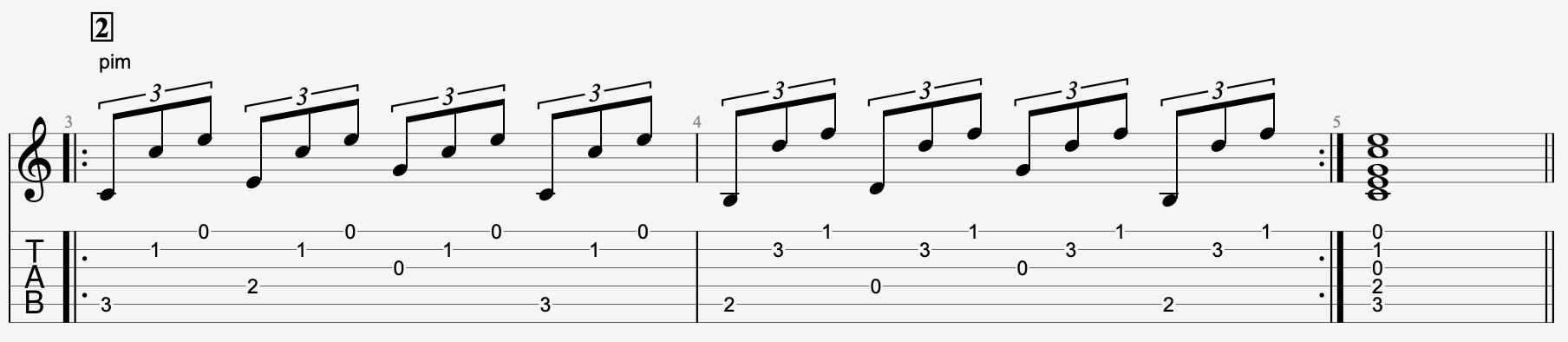
Giuliani opens with the simplest right-hand skill: a sequential roll. For
example, etude 2 uses what Robertson would call a forward roll, p-i-m, where
the index and middle fingers play the top two strings and the bass moves
across different strings.
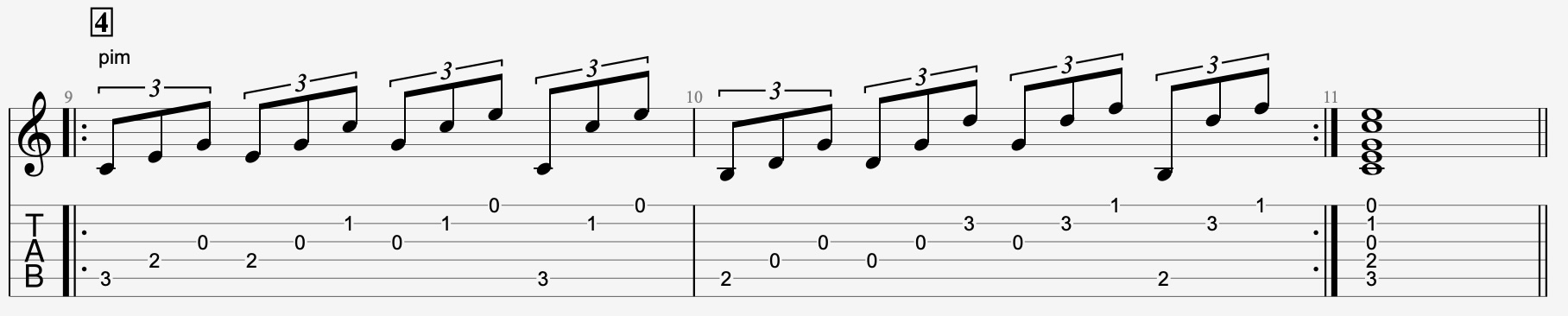
Many other variations are covered. Etude 4 moves the roll across different string sets.
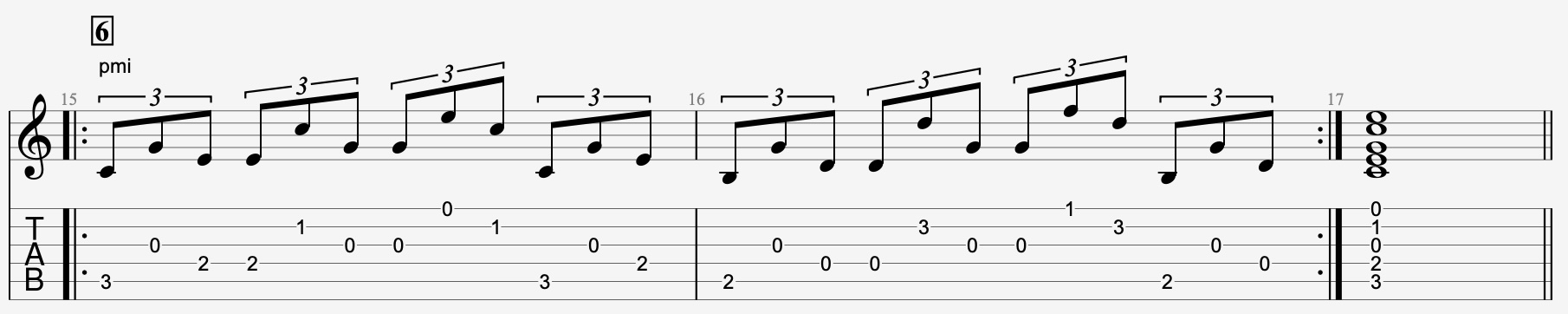
Etude 6 does the same, but uses what Robertson calls a mixed roll, p-m-i.
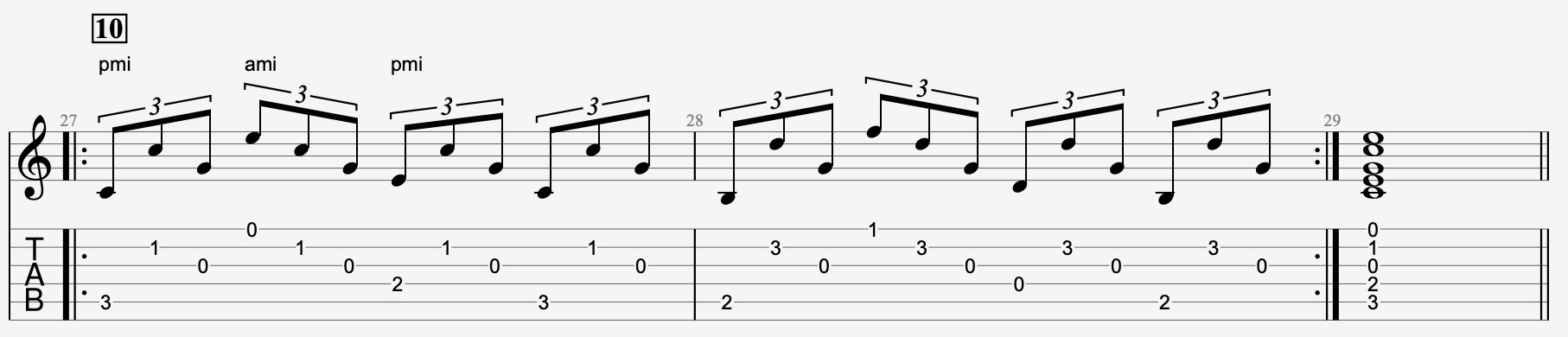
And etude 10 combines mixed (p-m-i) and backward (a-m-i) rolls. It is
doable but challenging, and an early illustration of how these etudes require
right-hand skills that the usual fingerstyle picking patterns do not cover.
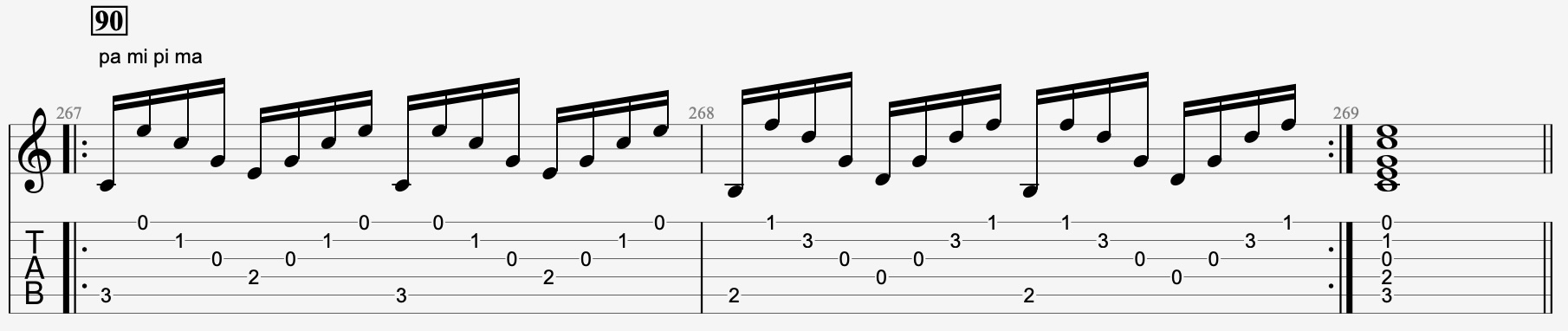
The collection also includes grand rolls covering more than three strings. For
example, etude 90 uses five strings and includes both a mixed roll of
p-a-m-i and a forward roll of p-i-m-a.
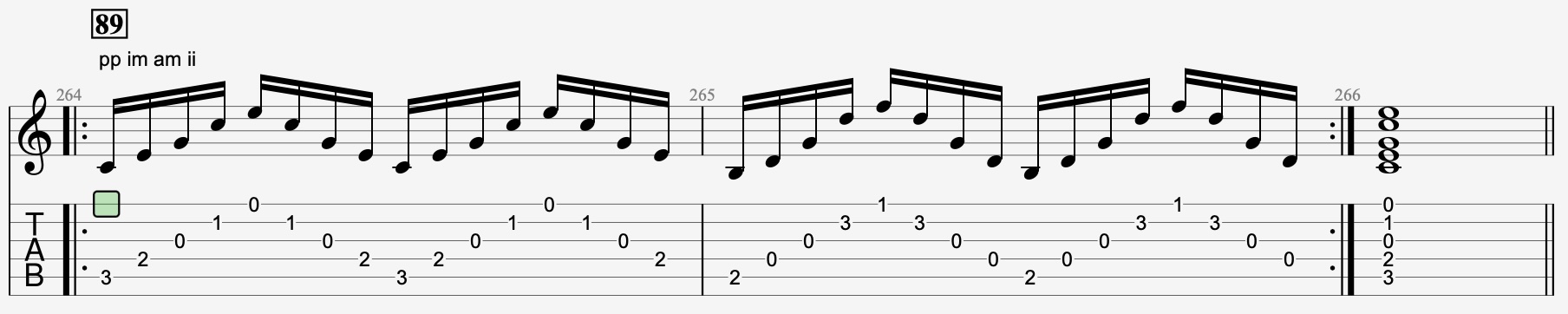
Some of the larger rolls also use economy picking, repeating the thumb on the way up and the index finger on the way down. Etude 89 is one example.
Pinches
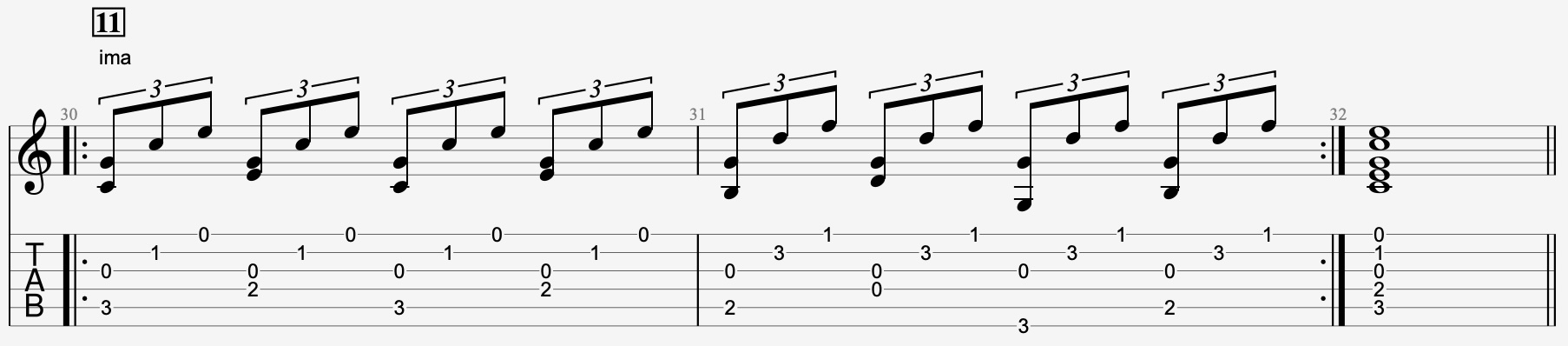
Giuliani covers another building block familiar to fingerstyle players: the pinch, where the thumb and fingers play at the same time. Etude 11 is a simple example, combining downbeat pinches with forward rolls.
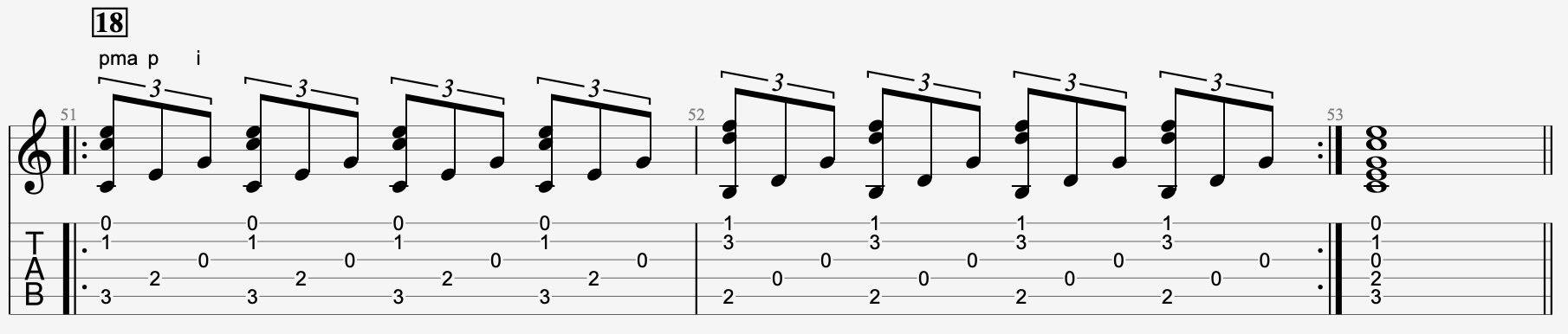
As the exercises advance, the pinch expands: instead of two simultaneous
strings, three or more sound at once, producing a partial chord. Etude 18
opens with a pma chord hit followed by a p-i pair.
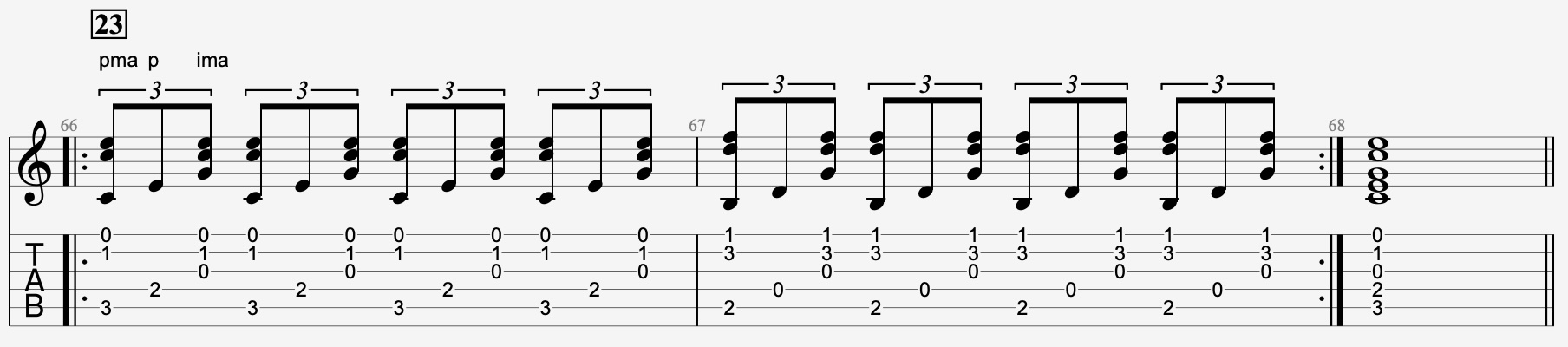
A more difficult example is etude 23, which uses denser pinches and places them both on and off the downbeats. Exercises like this force you to control fingers individually rather than plucking them as a block.
Alternating bass
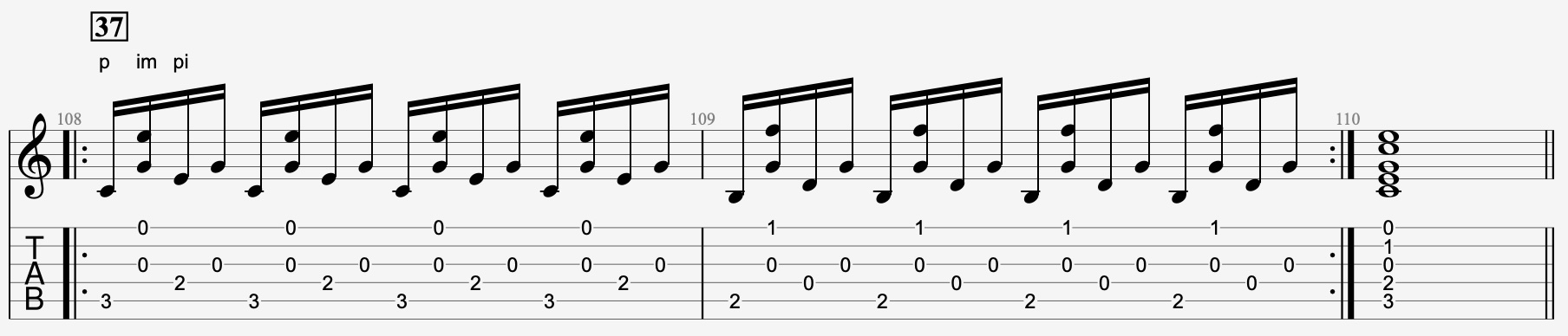
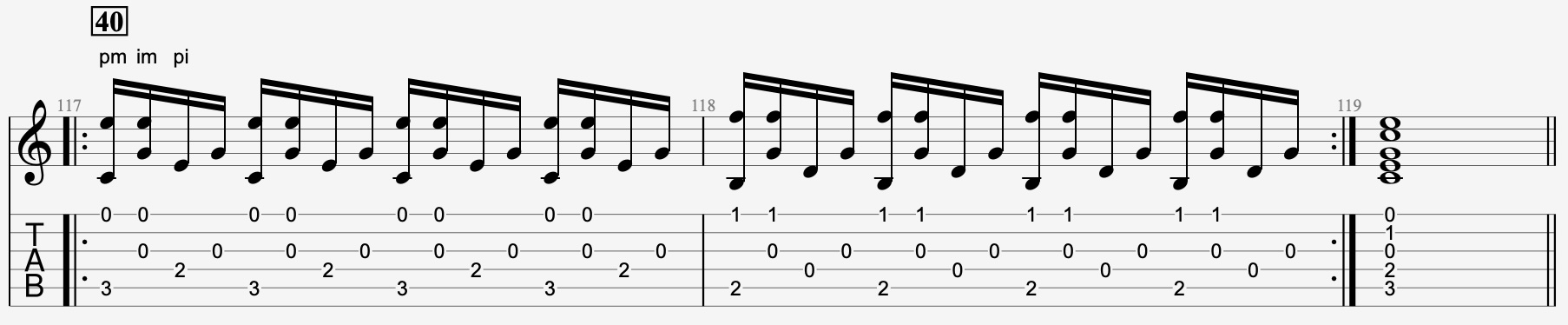
Etudes 36–50 cover alternating bass, home turf for any Travis-style player, but in ways that are both familiar and foreign.
A familiar example:
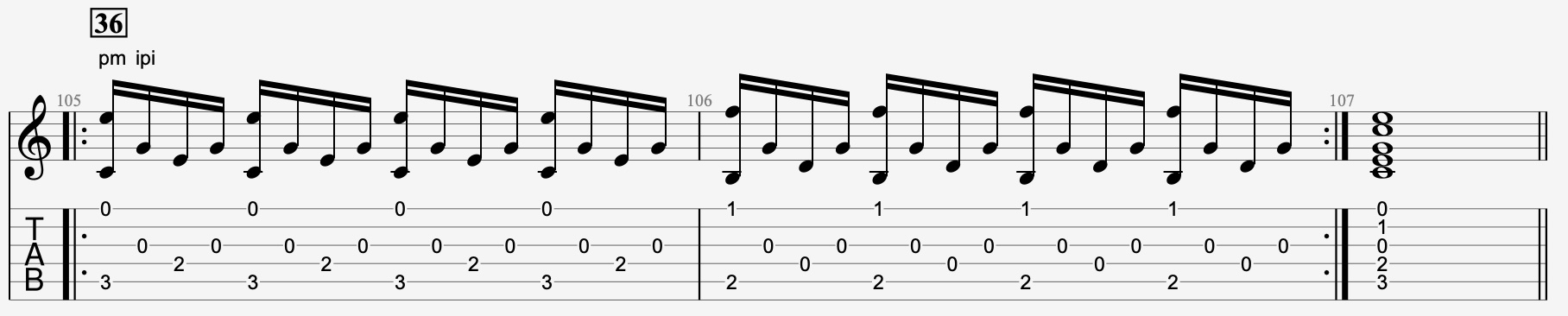
An example that is a bit unfamiliar, but not difficult:
And one that is likely to be both foreign and tricky, with pinches in atypical places for fingerstyle:
Finger pairs
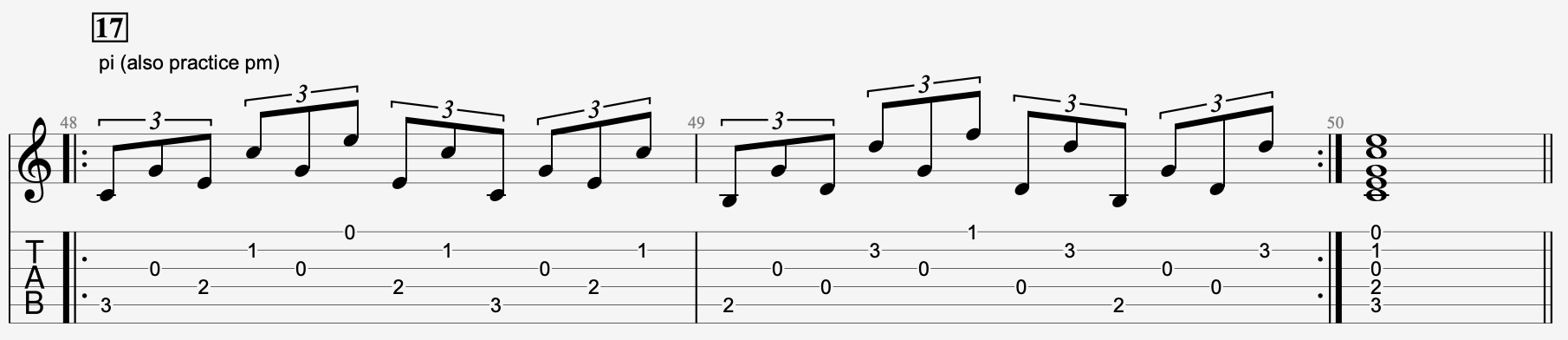
Classical single-note technique relies heavily on strict alternation between
two fingers, especially i-m and p-i.
Etude 17 is a basic illustration. It can be practiced with either p-i or
p-m.
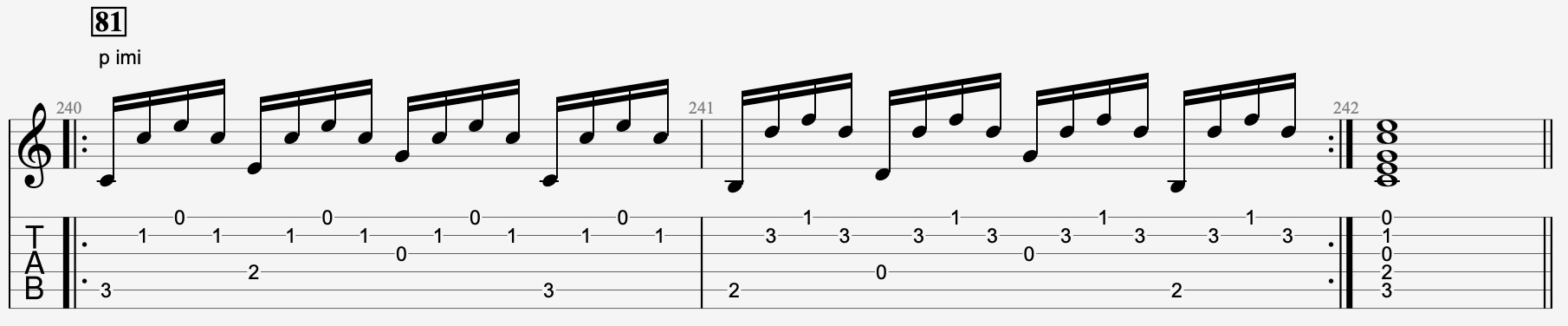
Etude 81 is also simple and focuses on i-m alternation.
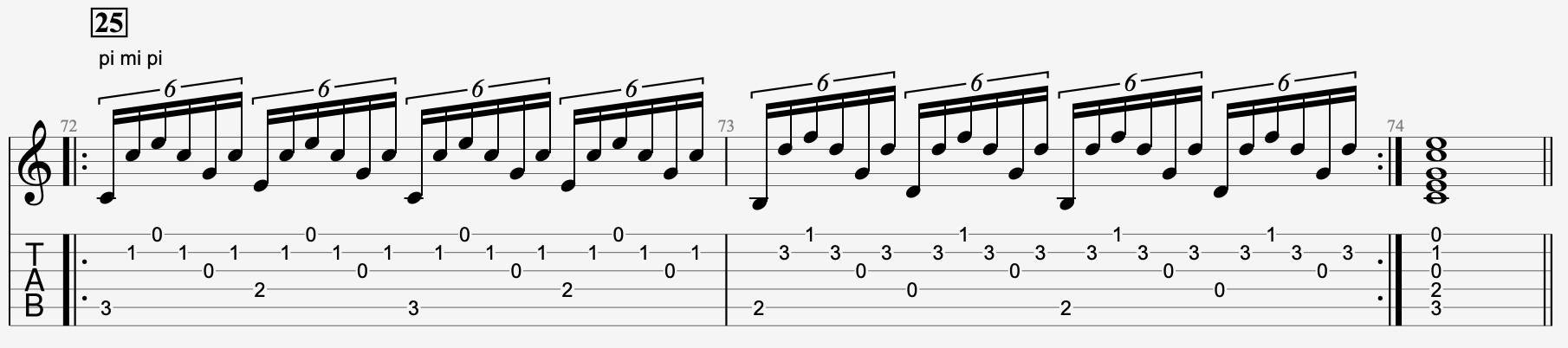
And etude 25 is a fun example that relies on both i-m and p-i.
Thumb independence
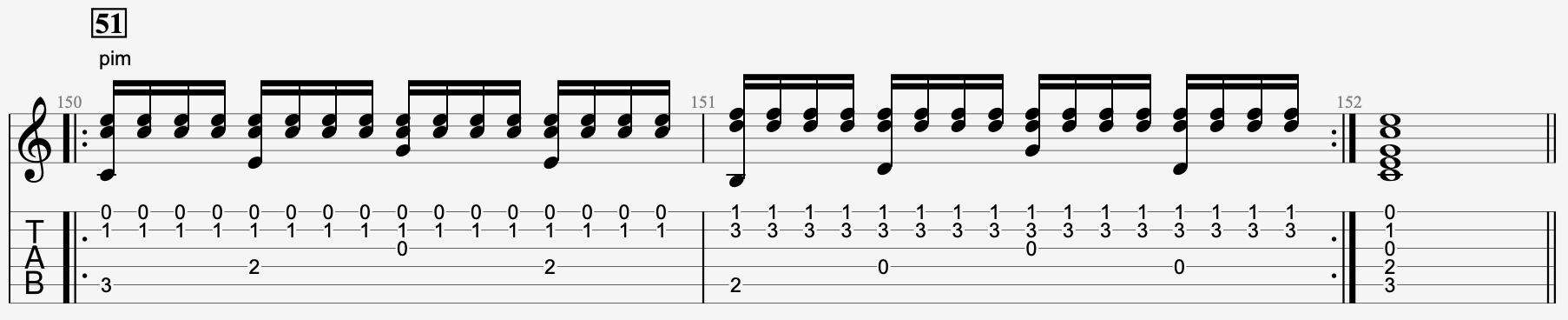
Etudes 51–65 are among the more demanding for non-classical players. A steady
im pinch is played on every 16th note and the bass moves across different
strings. When the bass lands on the downbeats, things feel familiar, as in
etude 51.
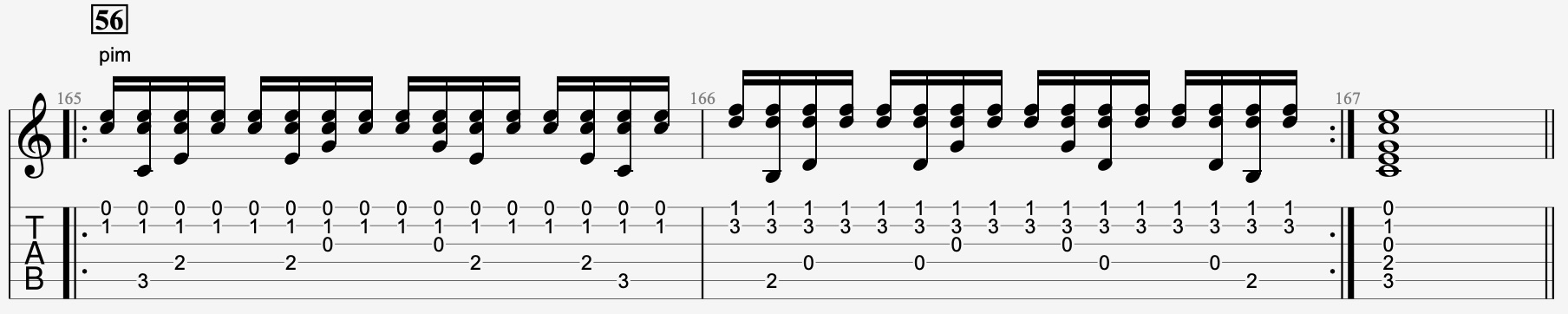
But when the bass lands on multiple offbeats, as in etude 56, things get quite tricky.
Chord placement
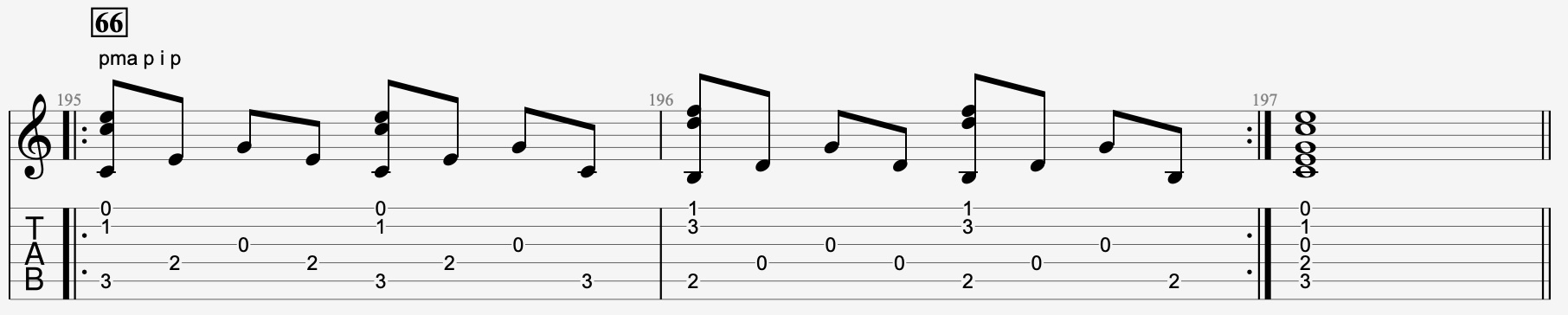
Etudes 66–80 alter the setup. The bass follows the same pattern in every bar, on strings 5, 4, and 3. The challenge is playing an interval on the top two strings anywhere in the measure without disrupting the bass.
A simple example:
And a diabolical one:
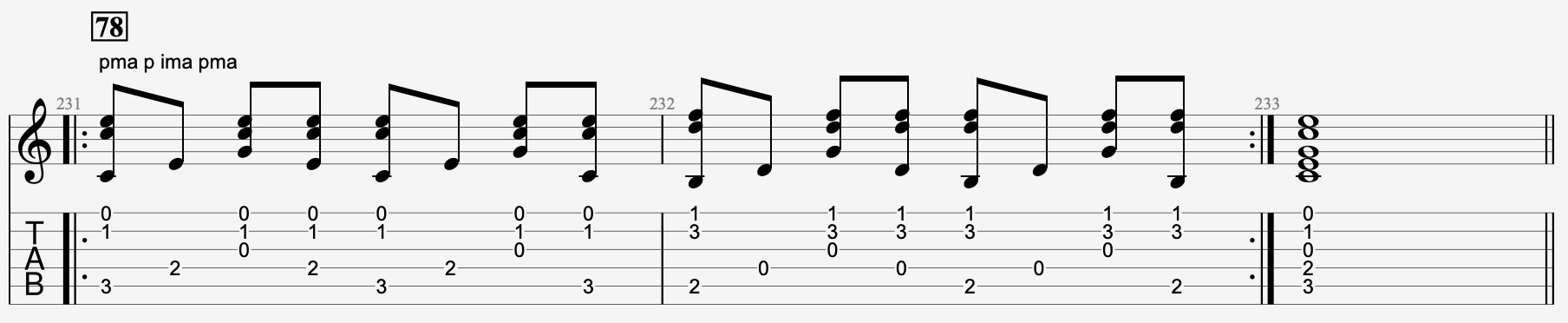
Favorites
I kept a running list of favorites as I worked: etudes that sounded like music rather than drills and that were fun to play, with fingers going brrrr along an interesting path. Only while writing this post did I notice that they all lean on finger pairs. Maybe that is no accident. Alternating pairs give the line freedom to move: rocking back and forth across adjacent strings, traveling through the chord, or jumping two or three strings at a time.
A finger-pair workout using m-a, i-m, and p-i.
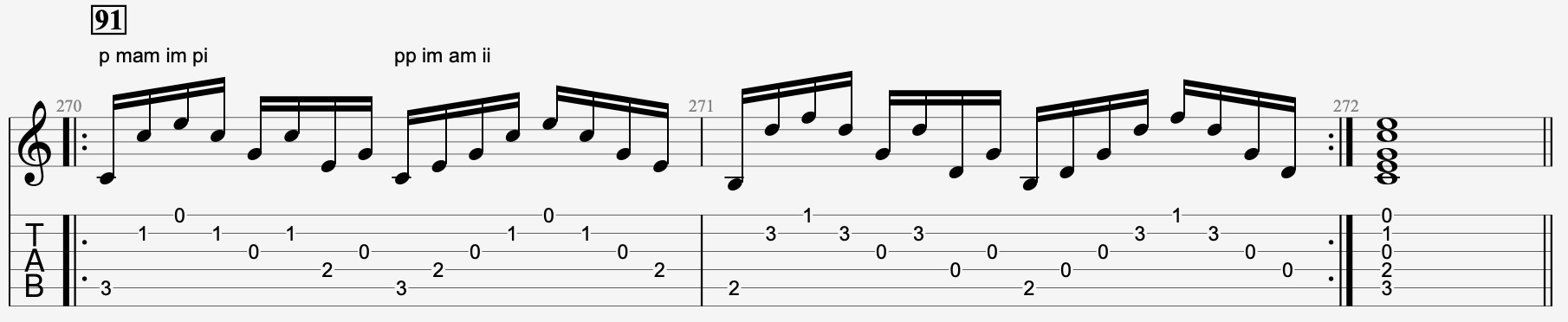
Finger pairs, plus motion across string sets and economy picking.
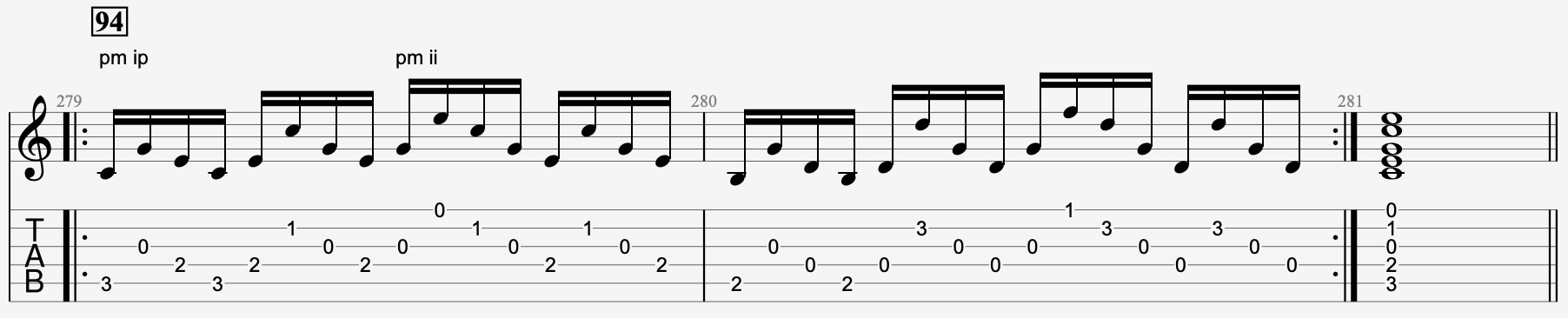
Finger pairs on the same string.
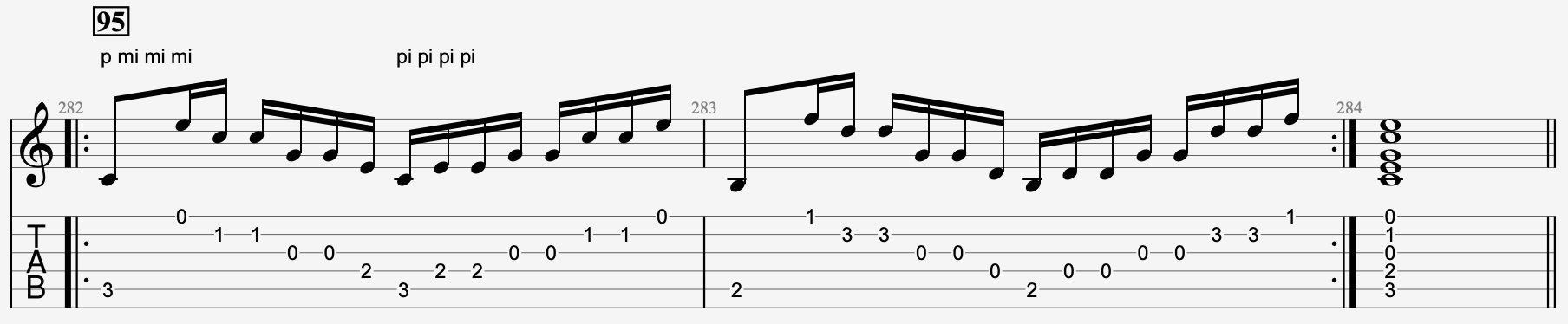
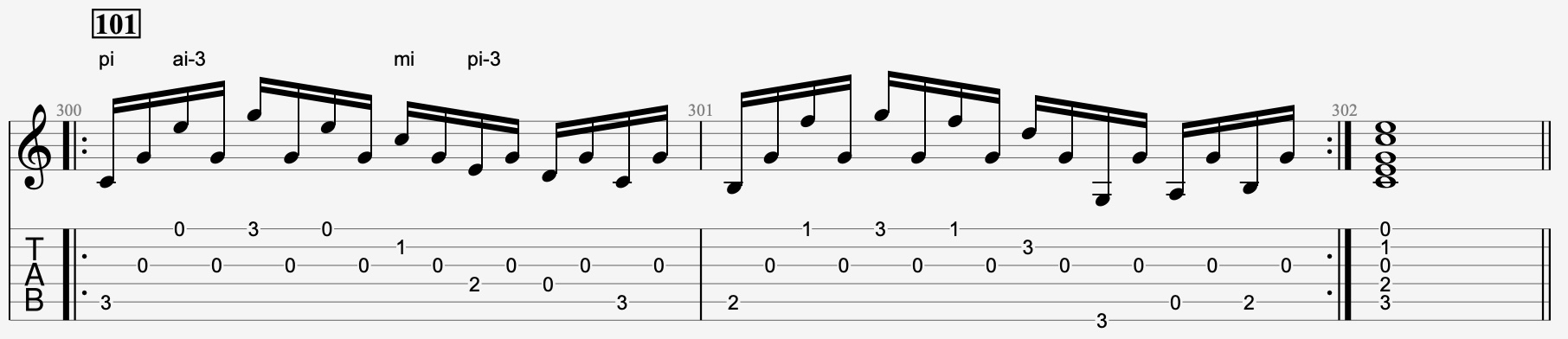
Finger pairs in various contexts.
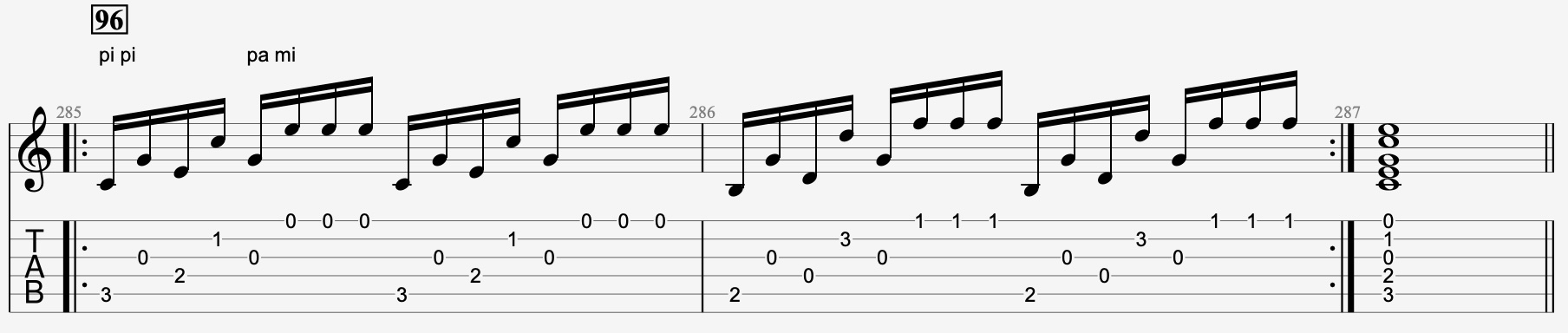
Finger pairs, plus melodic motion in the upper and lower registers.